
Archive Record
Images
Metadata
Catalog Number |
1960.7203.01 |
Object Name |
Document |
Description |
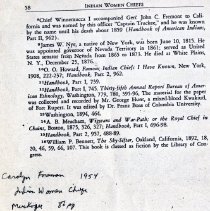
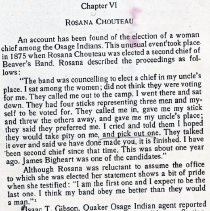
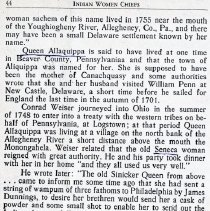
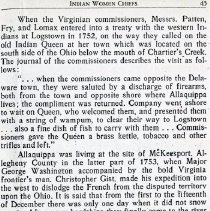
Carolyn Froeman 1954 Indian Women Chiefs Muskogee 86 pp Reprinted as Carolyn Thomas 1975 ISBN O-89201-019-3 Hoffman Print Co. Pages 58,59 Chief Winnemucca Gen. John C. Fremont Captain Truckee James W. Nye O. O. Howard George Hunt Dr. Franz Boas A. B. Meacham William P. Bennett Chapter VI ROSANA CHOUTEAU An account has been found of the election of a woman chief among the Osage Indians. This unusual event took place in 1875 when Rosana Chouteau was elected a second chief of Beaver's Band. Rosana described the proceedings as follows: "The band was councelling to elect a chief in my uncle's place. I sat among the women; did not think they were voting for me. They called me out to the camp. I went there and sat down. They had four sticks representing three men and myself to be voted for. They called me in, gave me my stick and threw the others away, and gave me my uncle's place; they said they preferred me. I cried and told them I hoped they would take pity on me, and pick out one. They talked it over and said we have done made you, it is finished. I have been second chief since that time. This was about one year ago. James Bigheart was one of the candidates." Although Rosana was reluctant to assume the office to which she was elected her statement shows a bit of pride when she testified: "I am the first one and I expect to be the last one. I think my band obey me better than they would a man."1 ''Isaac T. Gibson, Quaker Osage Indian agent reported to the commissioner of Indian Affairs from "Agency Station, Twelfth month 31, 1874 ... We went down to the Chouteau neighborhood, twelve miles from the agency; took with us a sewing-machine and some goods suitable for women's clothing. We stopped with Mother Chouteau, who had been elected second chief of the Beaver Band, being the only [Osage] Indian woman who has ever had the privilege of holding that position." Doctor Dugan, physician at the Osage Agency, publish-woman sachem of this name lived in 1755 near the mouth of the Youghiogheny River, Allegheney, Co., Pa., and there may have been a small Delaware settlement known by her name." Queen Allaquippa is said to have lived at one time in Beaver County, Pennsylvania and that the town of Aliquippa was named for her. She is supposed to have been the mother of Canachquasy and some authorities wrote that she and her husband visited William Penn at New Castle, Delaware, a short time before he sailed for England the last time in the autumn of 1701. Conrad Weiser journeyed into Ohio in the summer of 1748 to enter into a treaty with the western tribes on behalf of Pennsylvania, at Logstown; at that period Queen Allaquippa was living at a village on the north bank of the Allegheney River a short distance above the mouth the Monongahela. Weiser related that the old Seneca woman reigned with great authority. He and his party took dinner with her in her home "and they all used us very well." He wrote later: "The old Sinicker Queen from above . . . came to inform me some time ago that she had sent a string of wampum of three fathoms to Philadelphia by James Dunnings, to desire her brethren would send her a cask of powder and some small shot to enable her to send out the Indians boys to kill turkeys and fowls for her, whilst the men were gone to war against the French, that they may not be starved. "I gave her a shirt, a Dutch wooden pipe and some tobacco. She seemed to have taken a little affront because I took not sufficient notice of her coming down . . ." In 1749 when Celeron made his expedition down the Allegheny and Ohio he found the Queen living at Shannopin's Town, on the eastern bank of the Allegheny River ... within the present limits of Pittsburgh, although it has been asserted that her home was at McKees Rocks. In his journal on August 7 he wrote: "re-embarked and visited the village . . . called the Written Rock. The Iroquois inhabit this place, and it is an old woman of this nation who governs it. She regards herself as a sovereign . . . entirely devoted to the English." When the Virginian commissioners, Messrs. Patten, Fry, and Lomax entered into a treaty with the western Indians at Logstown in 1752, on the way they called on the old Indian "Queen at her town which was located on the south side of the Ohio below the mouth of Chartier's Creek. The journal of the commissioners describes the visit as follows: ". . . when the commissioners came opposite the Delaware town, they were saluted by a discharge of firearms, both from the town and opposite shore where Allaquippa lives; the compliment was returned. Company went ashore to wait on Queen, who welcomed them, and presented them with a string of wampum, to clear their way to Logstown .. . also a fine dish of fish to carry with them . . . Commissioners gave the Queen a brass kettle, tobacco and other trifles and left." Allaquippa was living at the site of McKeesport. Allegheny County in the latter part of 1753, when Major George Washington accompanied by the bold Virginia frontier's man. Christopher Gist, made his expedition into the west to dislodge the French from the disputed territory upon the Ohio. It is said that from the first to the fifteenth of December there was only one day when it did not snow or rain. After many hardships they finally came to the river intending to cross; the Ohio was very high and filled with floating ice and the only way to cross was on a raft. With one poor hatchet the men labored from morning until night before the raft was ready to be launched. They set out but the raft was crushed by the ice and they narrowly escaped drowning. Washington was thrown into the water where it was ten feet deep. "Fortunately, however, he catched by a fragment of the raft, and saved himself." They climbed upon the ice surrounding the raft, made their way to an island and at last to the opposite shore. Christopher Gist froze his hands and feet the cold was so intense. From that place Washington returned to Williamsburg without further accident. He and Gist reached Frazier's cabin at the mouth of Turtle Creek late in December and Frazer informed them that Queen Allaquippa was hurt by his failure to visit her (rest of the article is missing) |
Number of images |
4 |